

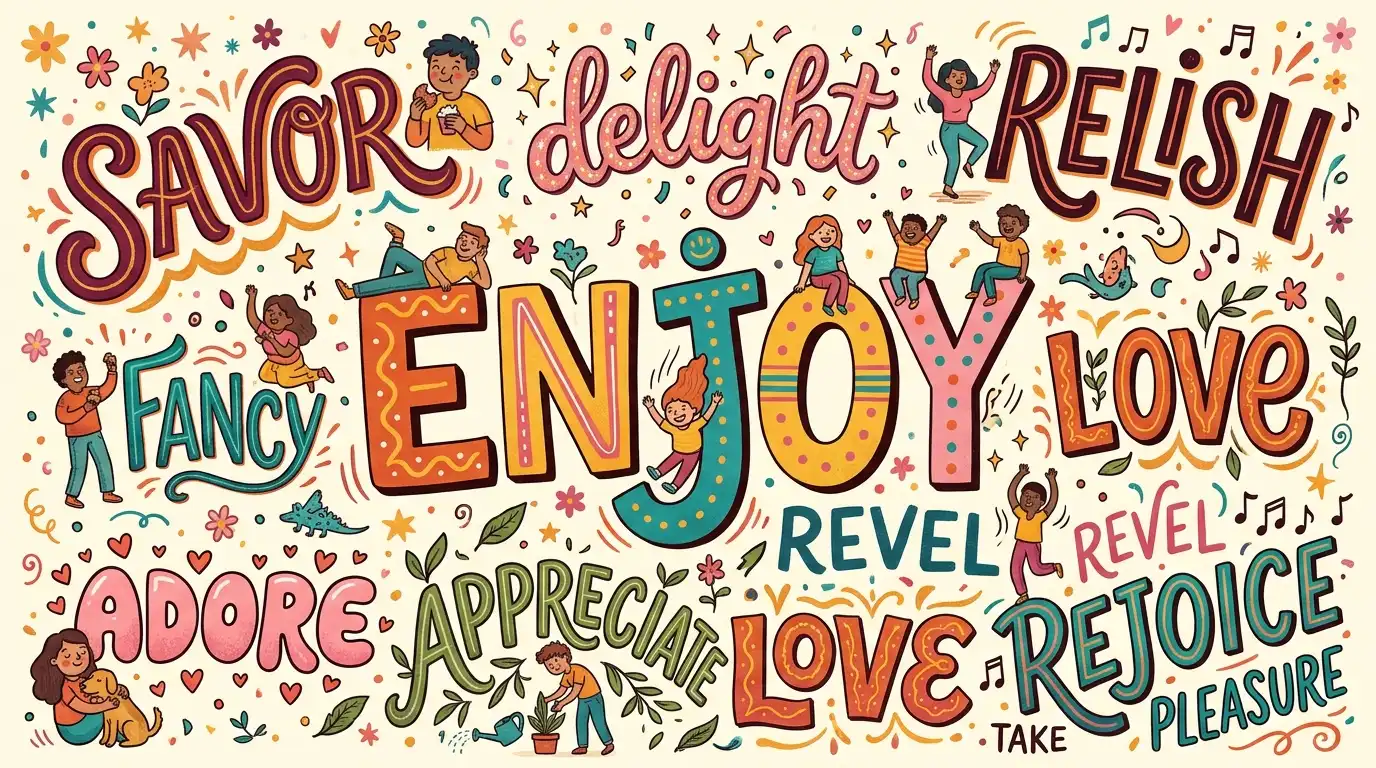
To feel happy or pleased while doing or having something.
Think about a child playing a favorite game or a friend watching a funny film. Both may say they enjoy the activity. The word can also describe taking pleasure in food, music, travel, or time with others. If you use enjoy synonyms, you can make your writing sound more natural and less repetitive. Some words show simple liking, while others express strong pleasure or a deep sense of value. This guide explains useful choices and shows when to use them.
Understanding enjoy synonyms
Simple meaning: To enjoy something means to feel happy or pleased while doing it, having it, or experiencing it. It can also mean to have or receive a benefit, such as good health or certain rights.
Part of speech: Enjoy is a verb. It is often followed by a noun or an -ing verb.
Example in context: I enjoy listening to music after school.
The word has two common uses:
- To feel pleasure: You enjoy a meal, a game, a song, or time with friends.
- To have or receive something good: A person may enjoy good health, freedom, or a special right.
Best Alternatives to enjoy synonyms
| Alternative | Simple meaning | Best use |
| Like | To feel pleased about something | Everyday speech |
| Love | To like something very much | Strong feelings |
| Take pleasure in | To feel happy while doing something | Clear, careful writing |
| Have fun | To enjoy an activity | Casual conversation |
| Relish | To enjoy something greatly | Food and special moments |
| Appreciate | To understand the value of something | People, art, and experiences |
| Delight in | To feel great joy from something | Strong pleasure |
| Savor | To enjoy something slowly | Food and special moments |
| Be fond of | To like someone or something | Personal feelings |
| Benefit from | To gain something good | Health, rights, and services |
Synonyms of enjoy by Situation
Everyday Words for Simple Pleasure
These words work well when you want to talk about things that make you happy. They are common in daily speech, messages, and simple writing.
Like — To feel pleased about a person, thing, or activity. It is a simple and common choice.
Example: I like reading short stories before bed.
Love — To feel very strong liking or pleasure. It shows a stronger feeling than a simple like.
Example: My sister loves dancing at family parties.
Have fun — To enjoy an activity and feel happy while doing it. This phrase is common in friendly speech.
Example: We had fun at the school fair.
Have a good time — To spend time in a happy and pleasant way. It often describes a visit, party, or trip.
Example: They had a good time at the beach.
Be fond of — To like someone or something, often over a long time. It can describe a person, hobby, or place.
Example: My grandfather is fond of old songs.
Be keen on — To like or feel excited about something. This phrase is common in British English.
Example: Sara is keen on learning new languages.
Get pleasure from — To feel happy because of an activity or experience. It is clear and works in both speech and writing.
Example: He gets pleasure from helping young children.
Take pleasure in — To feel happy while doing or experiencing something. It is a little more formal than “like.”
Example: She takes pleasure in caring for her garden.
Words for Strong Enjoyment and Joy
Sometimes a simple word does not show how much pleasure you feel. These choices express a stronger feeling or show that something gives you great joy.
Delight in — To feel great joy from something. It often shows strong pleasure.
Example: The little boy delights in playing with his toy cars.
Relish — To enjoy something greatly, often because it is special or exciting. It can describe food, a challenge, or an experience.
Example: She relished the chance to speak on stage.
Revel in — To take great pleasure in an experience or feeling. It often suggests that someone enjoys the moment fully.
Example: The team reveled in its big win.
Adore — To love someone or something very much. It is often used for people, pets, and favorite things.
Example: The children adore their new puppy.
Thrill in — To feel excited and pleased by something. This phrase is less common than “take delight in,” so use it only when it sounds natural in your sentence.
Example: He thrills in the challenge of solving hard puzzles.
Be thrilled by — To feel very excited and happy because of something. It often describes a special event or surprise.
Example: We were thrilled by the final show.
Be overjoyed by — To feel extremely happy because something good has happened. It is best for very strong feelings.
Example: Her parents were overjoyed by the good news.
Get a kick out of — To find something very funny or enjoyable. This is an informal phrase.
Example: My friends get a kick out of watching silly videos.

Words for Food, Art, and Special Moments
Some experiences are best enjoyed slowly or with care. These words help explain pleasure from food, music, art, nature, and other things that people value.
Savor — To enjoy something slowly and fully. It is often used for food, but it can also describe a special moment.
Example: We savored every bite of the fresh cake.
Appreciate — To notice the value or beauty of something and feel pleased by it. It can also show thanks.
Example: I appreciate the music in this film.
Admire — To enjoy or respect the good qualities of someone or something. It often focuses on beauty, skill, or talent.
Example: The students admire their art teacher’s work.
Marvel at — To feel great surprise and pleasure when you see something wonderful. It is useful for amazing sights or skills.
Example: Visitors marveled at the tall waterfall.
Take in — To look at, listen to, or experience something with care. It can show that you are enjoying what is around you.
Example: We sat quietly to take in the mountain view.
Bask in — To enjoy a good feeling, success, or attention. It often describes a person who feels happy about a special moment.
Example: The players basked in the praise after the match.
Indulge in — To allow yourself to enjoy something special, often as a treat. It can suggest that you are having more than usual.
Example: On Sundays, we indulge in a large family breakfast.
Feast on — To enjoy a large amount of good food. It is often used in a lively or playful way.
Example: The guests feasted on fresh fruit and warm bread.
Phrases for Activities, Experiences, and Benefits
Enjoy can also describe taking part in an activity or receiving something good. These phrases help when you want to explain an experience, service, right, or benefit.
Participate in — To take part in an activity or event. It does not always mean that the person feels pleasure, so use it when the focus is on joining in.
Example: All students can participate in the school games.
Make the most of — To use a chance or experience in the best way. It often suggests that someone wants to gain as much as possible from it.
Example: We made the most of our day off.
Get the most out of — To gain as much value or pleasure as possible from something. It is common in everyday speech.
Example: She gets the most out of her music lessons.
Benefit from — To gain something good or useful. It is especially helpful when enjoy means having an advantage.
Example: Many families benefit from the new park.
Take advantage of — To make good use of a chance, service, or offer. It can be positive, but it may sound unfair in some situations.
Example: We took advantage of the free bus service.
Experience — To take part in or go through an event or feeling. It is useful when talking about something a person has done or felt.
Example: The children experienced their first visit to a farm.
Make use of — To use something that is available. It focuses on using a resource rather than feeling pleasure.
Example: You can make use of the library during lunch.
Have access to — To be able to use or reach something. It is useful when talking about services, tools, or rights.
Example: Every student should have access to clean drinking water.
Words Similar to enjoy synonyms but with Different Meanings
Some words are close to enjoy, but they do not mean exactly the same thing. Knowing the difference can help you avoid mistakes.
Like vs. enjoy
Like: To feel pleased about someone or something.
Difference: Like often describes a general feeling. Enjoy usually focuses on pleasure during an activity or experience.
Example: I like football, and I enjoy playing it with my friends.
Love vs. enjoy
Love: To feel very strong affection or liking.
Difference: Love can show a deeper or stronger feeling. Enjoy usually describes pleasure from an activity or experience.
Example: I love my family, and I enjoy spending time with them.
Appreciate vs. enjoy
Appreciate: To understand the value or good qualities of something.
Difference: You can appreciate something without feeling pleasure from it. Enjoy focuses more on the happy feeling.
Example: I appreciate the artist’s skill, even though the painting is not my style.
Admire vs. enjoy
Admire: To respect or like someone’s good qualities or work.
Difference: Admire focuses on respect and approval. Enjoy focuses on pleasure.
Example: I admire my teacher’s hard work, and I enjoy her lessons.
Benefit from vs. enjoy
Benefit from: To gain something useful or helpful.
Difference: Benefit from focuses on a good result, not always on happiness. Enjoy often describes pleasure or a good experience.
Example: The students benefit from extra lessons, even when the work is not fun.
Participate in vs. enjoy
Participate in: To take part in an activity.
Difference: A person can take part in something without enjoying it. Enjoy means the person feels pleased by the experience.
Example: He participated in the race, but he did not enjoy running in the rain.
How to Choose the Right Synonym
The best alternative depends on what you want to say. These examples show how a small word change can affect the meaning or tone.
Original: I enjoy reading books.
Option 1: I like reading books.
Option 2: I love reading books.
What changes: Like shows a general feeling, while love shows a stronger one.
Original: We enjoyed the party.
Option 1: We had fun at the party.
Option 2: We had a good time at the party.
What changes: Both options sound natural and friendly. They focus on having a pleasant experience.
Original: She enjoys the taste of fresh fruit.
Option 1: She relishes the taste of fresh fruit.
Option 2: She savors the taste of fresh fruit.
What changes: Relishes shows strong pleasure, while savors suggests enjoying the taste slowly.
Original: He enjoys helping other people.
Option 1: He takes pleasure in helping other people.
Option 2: He gets pleasure from helping other people.
What changes: Both alternatives keep the meaning, but they sound a little more formal.
Original: The family enjoys good health.
Option 1: The family benefits from good health.
Option 2: The family has good health.
What changes: These options focus on health as a benefit or condition, not on an activity that gives pleasure.
Original: The students enjoy the chance to learn.
Option 1: The students value the chance to learn.
Option 2: The students make the most of the chance to learn.
What changes: Value shows that the chance matters to them. Make the most of shows that they use the chance well.
Common Mistakes When Using enjoy synonyms
Choosing a similar word is not always enough. The word must fit the meaning and grammar of your sentence.
Using “participate” when you mean pleasure
Unsuitable: I participate watching films at night.
Problem: Participate means to take part in an activity. It does not replace enjoy in this sentence, and it needs a phrase such as “participate in.”
Better: I enjoy watching films at night.
Using “appreciate” for every fun activity
Unsuitable: We appreciated playing football after school.
Problem: This sentence may sound as if you value the chance to play rather than simply have fun.
Better: We had fun playing football after school.

Using a strong word when a simple one is better
Unsuitable: I adore doing my homework every day.
Problem: Adore is a very strong word. It may sound too strong if you only mean that you like the task.
Better: I like doing my homework every day.
Forgetting the correct form after a phrase
Incorrect: She takes pleasure in to sing.
Problem: The phrase “take pleasure in” is followed by a noun or an -ing verb, not “to” plus a verb.
Better: She takes pleasure in singing.
Confusing “benefit from” with feeling happy
Unsuitable: I benefit from the funny film.
Problem: Benefit from suggests that the film gives you something useful. It does not clearly say that you had fun watching it.
Better: I enjoyed the funny film.
Using “savor” for every kind of activity
Unsuitable: I savor doing my homework.
Problem: Savor is most natural for food and special moments. It may sound odd for a normal task.
Better: I enjoy doing my homework.
Tips for Using enjoy Alternatives Naturally
- Think about the feeling. Use like for a simple feeling, love for a strong one, and delight in for great joy.
- Choose words that fit the activity. Savor works well for food and special moments. Have fun is better for games and parties.
- Use benefit from for useful results. It fits health, lessons, services, and other things that help you.
- Check the tone. Get a kick out of is casual, while take pleasure in sounds more formal.
- Check the grammar. Say “enjoy reading” and “take pleasure in reading.” Do not write “enjoy to read.”
- Avoid repeating the same word. Instead of writing “I enjoy music. I enjoy films. I enjoy books,” try “I love music, like films, and take pleasure in reading.”
- Keep the meaning clear. Change “We enjoy the free service” to “We benefit from the free service” when you mean that the service helps you, not that it gives you fun.
Frequently Asked Questions
What does enjoy mean?
Enjoy means to feel happy or pleased while doing or experiencing something. It can also mean to have or receive something good, such as good health or freedom.
What is the closest synonym for enjoy?
Like is one of the closest and most common alternatives. Take pleasure in is also a good choice when you want to describe feeling happy during an activity.
What is a simple alternative to enjoy?
Have fun is a simple choice when talking about an activity or event. For example, you can say, “We had fun at the park.”
Can I use enjoy and its synonyms interchangeably?
Not always. Like, love, relish, and benefit from have different levels or types of meaning, so choose the word that best fits your sentence.
Final Takeaway
The best word depends on the kind of pleasure or benefit you want to describe. A meal may be savored, a game can be fun, and a helpful service can bring benefits. When using enjoy synonyms, think about the feeling, activity, and person you are writing for. Pick two or three new words from this guide and use them in your own sentences this week.

Emily Carter is the editor and lead writer at The Synonymsly. With a background in English language and editorial writing, she has spent the past seven years helping students, writers and professionals find exactly the right word. Emily creates clear, practical synonym guides with real example sentences, carefully checking meaning, tone and usage so readers can expand their vocabulary with confidence. Away from her desk, she enjoys reading classic novels and collecting interesting words she hears in everyday conversation.