

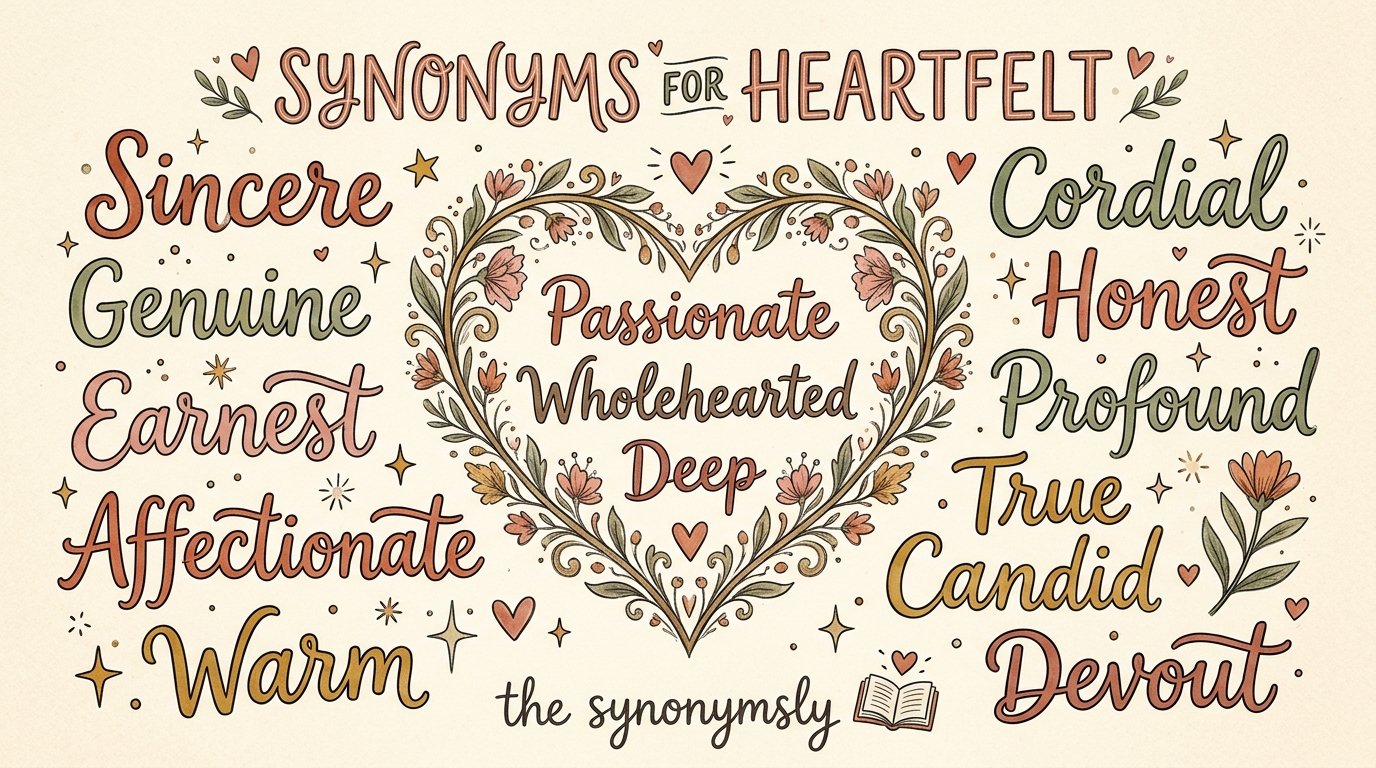
Heartfelt means showing deep, honest feelings that come from the heart.
A Word in Everyday Life
Imagine receiving a thank-you note from a close friend. The words are simple, but you can feel the love and care behind them. You might call it a heartfelt message. This word describes feelings that are honest, deep, and real. People use it for kind words, warm wishes, thanks, apologies, and personal messages. The phrase heartfelt synonyms includes words such as sincere, genuine, warm, and touching. Each word has a slightly different meaning. This guide will help you choose the best alternative for your message or writing.
Understanding Heartfelt Synonyms
Simple meaning: Heartfelt means showing real and deep feelings. It describes words or actions that come from honest emotions.
Part of speech: Heartfelt is an adjective. It describes a noun, such as a message, apology, thanks, wish, or speech.
Example in context: She gave her mother a heartfelt thank-you for all her support.
Heartfelt is often used in these situations:
- Kind words: A heartfelt message shows care and love.
- Thanks: Heartfelt thanks show true gratitude.
- Apologies: A heartfelt apology shows real regret.
- Wishes: Heartfelt wishes express warm feelings for someone.
- Speeches: A heartfelt speech shares deep and honest emotions.
Best Alternatives to Heartfelt Synonyms
| Alternative | Simple meaning | Best use |
| Sincere | Honest and real | Thanks and apologies |
| Genuine | True, not fake | Feelings and care |
| Earnest | Serious and honest | Requests and promises |
| Warm | Full of kindness | Greetings and messages |
| Deeply felt | Strongly felt inside | Personal feelings |
| Touching | Making someone feel strong emotion | Stories and messages |
| Moving | Causing deep feelings | Speeches and events |
| Emotional | Showing strong feelings | Personal moments |
| Meaningful | Full of importance or feeling | Gifts and words |
| Affectionate | Showing love and care | Family and close friends |
| Personal | Connected to someone’s own feelings | Notes and letters |
| Grateful | Showing thanks | Thank-you messages |
These alternatives can describe similar feelings, but each one has its own use. Choose the word that best matches the message or action you want to describe.
Synonyms of Heartfelt by Situation
Words for Honest and Real Feelings
These words are useful when you want to show that someone’s feelings are true. They work well for apologies, promises, thanks, and personal messages.
Sincere — Showing honest feelings without pretending.
Example: He sent a sincere message to his teacher.
Genuine — Real and not false.
Example: Her genuine smile made everyone feel welcome.
Earnest — Serious, honest, and full of purpose.
Example: The student made an earnest request for help.
Honest — Showing the truth and not hiding your real feelings.
Example: She gave an honest answer about her mistake.
Authentic — Real and true to who someone is.
Example: His authentic words showed how much he cared.
Truthful — Saying what is true.
Example: She wrote a truthful note about her feelings.
Wholehearted — Showing complete and strong support or feeling.
Example: We gave the new plan our wholehearted support.
Open — Willing to share your real thoughts and feelings.
Example: He had an open talk with his brother.
Words for Love, Care, and Kindness
Heartfelt words often show love and care for another person. These alternatives are helpful for family messages, friendship notes, and kind wishes.
Warm — Showing kindness and care.
Example: They sent us a warm welcome.
Affectionate — Showing love or fondness for someone.
Example: She gave her son an affectionate hug.
Loving — Full of love and care.
Example: He wrote a loving message to his wife.
Caring — Showing that you want to help or protect someone.
Example: The nurse gave the child a caring smile.
Tender — Showing gentle love and care.
Example: The father spoke in a tender voice.
Kind — Friendly and thoughtful toward others.
Example: Her kind words helped me feel better.
Compassionate — Showing care for someone who is sad or in trouble.
Example: The teacher gave a compassionate reply to the child.
Thoughtful — Showing that you care about another person’s needs or feelings.
Example: He sent a thoughtful card to his friend.
Words for Deep and Strong Emotions
Some messages carry strong feelings. These words help describe moments that touch the heart or cause a person to feel deeply.
Touching — Making someone feel strong emotion.
Example: Her touching words made her father smile.
Moving — Causing deep feelings, often of love, sadness, or joy.
Example: The speaker shared a moving story about his family.
Emotional — Showing or expressing strong feelings.
Example: Their goodbye was an emotional moment.
Deeply felt — Felt strongly and sincerely.
Example: His deeply felt thanks showed how much he valued their help.
Powerful — Having a strong effect on people’s feelings.
Example: The film ended with a powerful message about family.
Passionate — Showing strong feelings or beliefs.
Example: She gave a passionate speech about helping children.
Poignant — Causing a deep feeling, often with both sadness and beauty.
Example: The letter was a poignant reminder of their friendship.

Words for Thanks, Praise, and Apologies
Heartfelt is often used when people thank someone, praise their work, or say sorry. These alternatives help make such messages clear and natural.
Grateful — Feeling thankful for someone’s help or kindness.
Example: I am grateful for your support.
Appreciative — Showing that you value someone’s help or effort.
Example: The team was appreciative of the coach’s time.
Thankful — Feeling happy because someone has helped you.
Example: She was thankful for her friend’s advice.
Regretful — Feeling sorry about something you did.
Example: He gave a regretful reply after the mistake.
Remorseful — Feeling deep regret for doing something wrong.
Example: The boy was remorseful after hurting his friend’s feelings.
Apologetic — Showing that you are sorry.
Example: She sounded apologetic when she called her teacher.
Respectful — Showing care and respect for someone.
Example: He wrote a respectful message to his former teacher.
Phrases That Express Heartfelt Feelings
Sometimes a short phrase is more natural than one word. These expressions can help you describe honest emotions in letters, speeches, and everyday messages.
From the heart — Said with real and honest feelings.
Example: Her words came straight from the heart.
With all my heart — With deep love or strong feeling.
Example: I thank you with all my heart.
Deeply meaningful — Having strong personal value or importance.
Example: Their visit was deeply meaningful to our family.
Full of feeling — Showing strong emotion.
Example: He gave a speech full of feeling.
True to the heart — Honest and connected to real feelings.
Example: Her message was true to the heart.
With genuine care — Showing real concern for another person.
Example: The doctor spoke with genuine care.
Words Similar to Heartfelt but with Different Meanings
Some words can describe strong feelings but do not always mean the same as heartfelt. Knowing the difference helps you avoid using the wrong word.
Emotional vs. Heartfelt
Emotional: Emotional means showing or feeling strong feelings. These feelings can include happiness, anger, sadness, or excitement.
Difference: Heartfelt usually points to honest and deep feelings. Emotional can describe any strong feeling, whether it is positive or negative.
Example: The film was emotional, but her heartfelt message was full of love.
Touching vs. Heartfelt
Touching: Touching describes something that makes people feel strong emotion.
Difference: A heartfelt message comes from real feelings. A touching message or story has a strong effect on the person who reads or hears it.
Example: His heartfelt letter was touching because it reminded her of their friendship.
Passionate vs. Heartfelt
Passionate: Passionate means showing strong feelings about a person, activity, or belief.
Difference: Heartfelt focuses on honest feelings. Passionate often shows great energy or strong interest.
Example: She gave a passionate speech about protecting nature.
Meaningful vs. Heartfelt
Meaningful: Meaningful means important or full of value.
Difference: Something can be meaningful because it has a special purpose or memory. It does not always need to show deep emotion.
Example: The gift was meaningful because it reminded him of his childhood.
Affectionate vs. Heartfelt
Affectionate: Affectionate means showing love or fondness.
Difference: Heartfelt can describe many kinds of deep feelings, including thanks and regret. Affectionate mainly describes love and care.
Example: Her affectionate hug showed how much she loved her daughter.
How to Choose the Right Synonym
The best word depends on the feeling you want to express. These examples show how small changes can affect a sentence.
Comparison 1: Thanking someone
Original: She gave him a heartfelt thank-you.
Option 1: She gave him a sincere thank-you.
Option 2: She gave him a grateful thank-you.
What changes: Sincere focuses on honest feelings, while grateful focuses on being thankful.
Comparison 2: Writing a message
Original: He sent a heartfelt message to his friend.
Option 1: He sent a warm message to his friend.
Option 2: He sent a touching message to his friend.
What changes: Warm shows kindness, while touching suggests that the message may bring strong feelings.
Comparison 3: Saying sorry
Original: She gave a heartfelt apology.
Option 1: She gave a sincere apology.
Option 2: She gave a remorseful apology.
What changes: Sincere means honest, while remorseful shows deep regret for a mistake.
Comparison 4: Giving a speech
Original: The teacher gave a heartfelt speech.
Option 1: The teacher gave a moving speech.
Option 2: The teacher gave an emotional speech.
What changes: Moving focuses on the effect on listeners, while emotional describes the strong feelings in the speech.
Comparison 5: Showing love
Original: He wrote a heartfelt letter to his mother.
Option 1: He wrote a loving letter to his mother.
Option 2: He wrote an affectionate letter to his mother.
What changes: Loving and affectionate focus more directly on care and love.
Comparison 6: Showing support
Original: The group gave her heartfelt support.
Option 1: The group gave her wholehearted support.
Option 2: The group gave her genuine support.
What changes: Wholehearted shows complete support, while genuine shows that the support is real.
Common Mistakes When Using Heartfelt Synonyms
Choosing a similar word without checking its meaning can make a sentence unclear. Here are some common mistakes and better ways to write them.
Using Emotional When You Mean Loving
Unsuitable: He sent an emotional message full of love.
Problem: Emotional is a broad word. It does not clearly show that the message expresses love.
Better: He sent a loving message full of care.
Using Grateful to Describe a Person’s Message
Unsuitable: She wrote a grateful letter to her friend.
Problem: Grateful usually describes how a person feels. If you want to describe the letter, thankful or full of thanks may sound more natural.
Better: She wrote a letter full of thanks to her friend.
Using Passionate for Every Deep Feeling
Unsuitable: He gave a passionate apology to his sister.
Problem: Passionate often shows strong energy or belief. It may not express regret clearly.
Better: He gave a sincere apology to his sister.
Using Touching When You Mean Honest
Unsuitable: I need a touching answer from you.
Problem: Touching describes something that causes strong feelings. It does not always mean that the answer is honest.
Better: I need an honest answer from you.
Confusing Heartfelt with Heartily
Unsuitable: She gave a heartily thank-you.
Problem: Heartfelt is an adjective used before a noun. Heartily is an adverb and does not fit this sentence.
Better: She gave a heartfelt thank-you.

Using Affectionate for Every Kind of Message
Unsuitable: He sent an affectionate apology to his boss.
Problem: Affectionate usually shows love or fondness. A work apology may need a word that shows honesty and regret.
Better: He sent a sincere apology to his boss.
Tips for Using Heartfelt Alternatives Naturally
Use these tips to make your writing clear and full of meaning.
- Think about the feeling. Choose sincere for honesty, affectionate for love, and grateful for thanks.
- Match the word to the message. A heartfelt apology should show regret. A heartfelt greeting should show warmth and care.
- Choose simple words for daily use. Warm, kind, honest, and loving are easy to understand.
- Use stronger words only when needed. Passionate and deeply felt can show strong emotions, so do not use them for every small message.
- Check the noun you are describing. You can write a sincere apology, a warm greeting, or a moving speech.
- Avoid using the same word too often. Change some uses of heartfelt to sincere, warm, or touching when the meaning fits.
Revision example 1:
Before: She sent a heartfelt message. It was a heartfelt message of thanks.
After: She sent a warm message. It was a sincere way to say thank you.
The new version avoids repeating the same word and explains the feeling more clearly.
Revision example 2:
Before: He gave a heartfelt speech about his parents. His heartfelt words made everyone smile.
After: He gave a moving speech about his parents. His sincere words made everyone smile.
The revised version uses moving to describe the speech’s effect and sincere to describe the honest words.
Revision example 3:
Before: I want to send a heartfelt message to my teacher.
After: I want to send a sincere message to my teacher to thank her for her help.
The revised sentence explains the reason for the message.
Frequently Asked Questions
What does heartfelt mean?
Heartfelt means honest and full of deep feelings. It is often used for messages, thanks, apologies, wishes, and speeches.
What is the closest synonym for heartfelt?
Sincere is one of the closest alternatives. Both words can describe feelings or messages that are honest and real.
What is a simple alternative to heartfelt?
Warm, honest, and sincere are simple alternatives. Use warm for kindness and sincere when you want to show that feelings are real.
Can I use heartfelt and its synonyms interchangeably?
Not always. Sincere, touching, emotional, and affectionate have different meanings, so choose the word that best fits the situation.
Final Takeaway
Heartfelt is a useful word for showing honest and deep feelings. You can use alternatives such as sincere, warm, loving, touching, and grateful to make your writing more clear. Each word adds a different feeling, so think about the message before choosing one. When learning heartfelt synonyms, start with two or three words that you use often. Practise them in thank-you notes, messages, and short sentences.

Emily Carter is the editor and lead writer at The Synonymsly. With a background in English language and editorial writing, she has spent the past seven years helping students, writers and professionals find exactly the right word. Emily creates clear, practical synonym guides with real example sentences, carefully checking meaning, tone and usage so readers can expand their vocabulary with confidence. Away from her desk, she enjoys reading classic novels and collecting interesting words she hears in everyday conversation.