

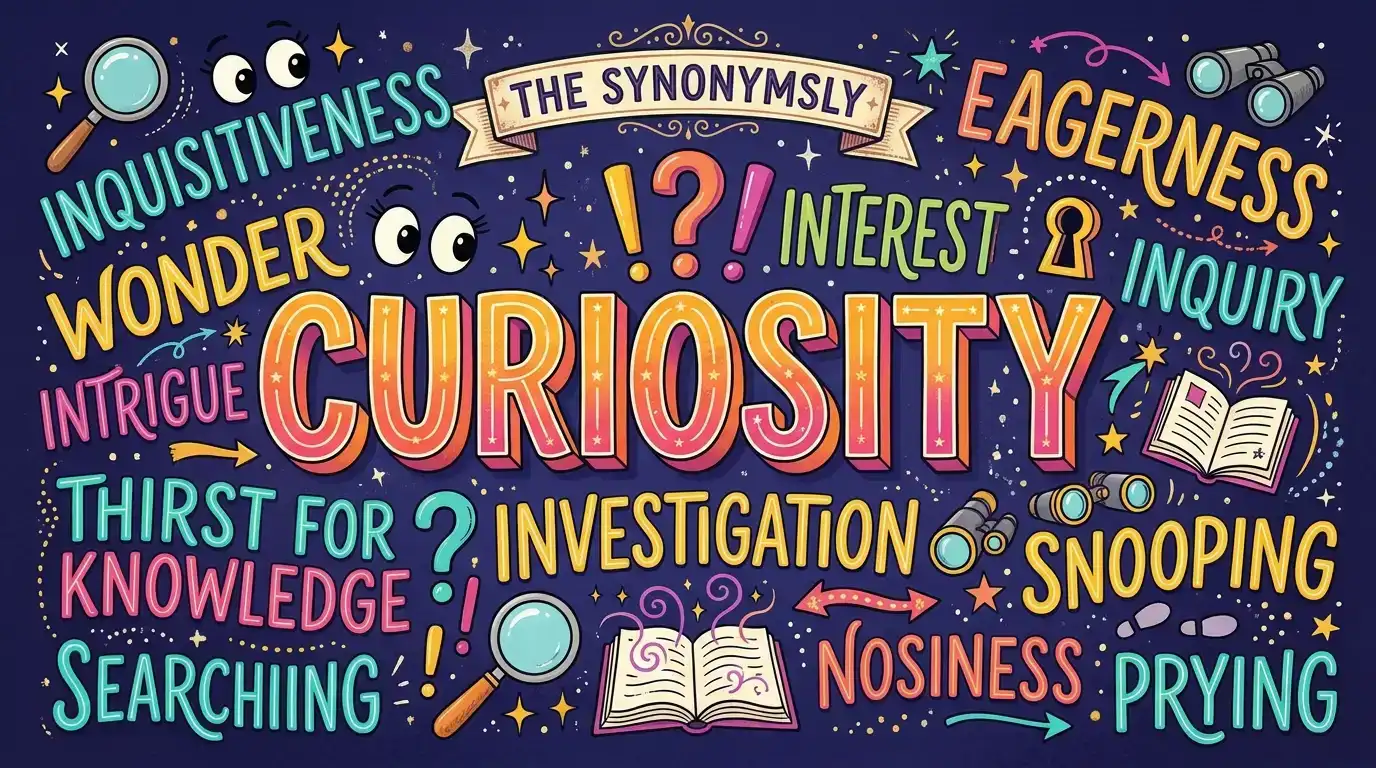
Curious means wanting to learn something or finding something strange.
Imagine seeing a small box with a bright red lock. You may feel curious about what is inside. Or you may see a strange shape in the sky and call it curious. The word curious has both meanings. It can describe someone who wants to know more, or something that seems odd or unusual. The best curious synonyms depend on which meaning you want. This guide shares easy alternatives, simple meanings, and clear examples to help you choose the right word.
Understanding Curious Synonyms
Simple meaning: Curious can mean wanting to know or learn more. It can also mean strange, unusual, or hard to explain.
Part of speech: Curious is an adjective. It describes a person, thing, or situation.
Example in context: The curious child asked how the birds built their nests.
The word curious has two common uses:
- Wanting to know: A curious person asks questions and likes to learn new things.
- Strange or unusual: A curious event or object is not common or easy to understand.
These meanings are different, so one synonym will not fit every sentence.
Best Alternatives to Curious
| Alternative | Simple meaning | Best use |
| Inquisitive | Eager to ask and learn | Describing a person who asks questions |
| Interested | Wanting to know about something | Everyday speech |
| Eager | Excited and ready to learn | School and daily life |
| Intrigued | Very interested in finding out more | Stories and conversations |
| Keen | Showing a strong wish to do or learn something | Everyday and work settings |
| Questioning | Often asking questions | Describing a thoughtful person |
| Nosy | Asking too much about other people | Informal speech, often negative |
| Observant | Quick to notice things | Describing someone who pays attention |
| Odd | Strange or not usual | Describing a thing or event |
| Unusual | Not common or expected | General writing |
| Peculiar | Different in a strange way | Describing a strange thing |
| Strange | Not normal or easy to explain | Everyday speech |
Synonyms of Curious by Situation
Words for Someone Who Wants to Learn
Use these words when you describe a person who wants to know more. They work well in school, daily talks, and stories.
Inquisitive — A person who likes to ask questions and find answers.
Example: The inquisitive student asked about every part of the lesson.
Interested — Wanting to know more about a subject or activity.
Example: Sara is interested in how plants grow.
Eager — Very ready and happy to learn or do something.
Example: The eager child opened her new book.
Keen — Showing a strong wish to learn or take part.
Example: He is keen to learn how to play the guitar.
Questioning — Often asking questions to understand something.
Example: Her questioning mind helped her learn new facts.
Curious-minded — Having a mind that enjoys asking questions and learning.
Example: A curious-minded child may ask many questions about nature.
Knowledge-seeking — Always trying to gain more knowledge.
Example: The knowledge-seeking student spent time reading science books.
Open to learning — Ready to learn new things and ideas.
Example: He is open to learning from other people.
Words for Strong Interest
These words show that someone has more than a small interest in something. Use them when a person wants to learn more because a subject has caught their attention.
Intrigued — Very interested because something is not clear or easy to explain.
Example: I was intrigued by the old map.
Fascinated — Having a very strong interest in something.
Example: The children were fascinated by the sea animals.
Absorbed — Giving full attention to something.
Example: She was absorbed in her storybook.
Engrossed — So interested that you give little attention to anything else.
Example: He was engrossed in the science show.
Enthusiastic — Showing great interest and excitement.
Example: The enthusiastic class joined the reading activity.
Passionate — Having a strong love for a subject or activity.
Example: She is passionate about learning new languages.
Excited — Feeling happy and full of interest about something.
Example: The children were excited to see the new robot.
Words for Someone Who Notices Details
Sometimes a curious person does not ask many questions. Instead, they watch closely and notice small things. These words describe that kind of person.
Observant — Quick to see or notice things.
Example: The observant girl noticed a small bird near the tree.
Attentive — Giving close attention to what is happening.
Example: The attentive student listened to every part of the lesson.
Watchful — Looking carefully at what is happening around you.
Example: The watchful guard saw the open gate.
Alert — Quick to notice something important.
Example: The alert driver saw the child near the road.
Careful — Taking time to look at things closely.
Example: The careful reader noticed a small mistake.
Mindful — Paying attention to what is happening or what you are doing.
Example: She was mindful of every sound in the quiet room.

Words for Asking Too Many Questions
Some words describe curiosity that may feel rude or unwanted. Use them with care because they can make a person sound unkind.
Nosy — Too interested in other people’s private lives.
Example: His nosy questions made his friend uncomfortable.
Prying — Trying to learn things that someone wants to keep private.
Example: The prying neighbour asked about their family matters.
Inquisitive — Eager to ask questions; usually positive, but it can sound negative in some situations.
Example: The inquisitive guest asked many personal questions.
Intrusive — Asking or doing things that do not respect another person’s privacy.
Example: Her intrusive questions upset the family.
Curiosity-driven — Led by a wish to find out more.
Example: His curiosity-driven search helped him find the answer.
Words for Something Strange or Unusual
Curious can also describe something that seems odd or different. Use these alternatives when you are talking about an object, event, sound, or situation rather than a person who wants to learn.
Odd — Different from what is normal.
Example: There was an odd mark on the wall.
Unusual — Not common or not often seen.
Example: We saw an unusual bird in the garden.
Peculiar — Strange in a way that catches your attention.
Example: The box made a peculiar sound.
Weird — Very strange or hard to understand; common in casual speech.
Example: That was a weird dream.
Bizarre — Very strange and surprising.
Example: The film showed a bizarre world.
Uncommon — Not seen or found very often.
Example: The shop sells uncommon plants.
Quirky — Strange in a fun or interesting way.
Example: She has a quirky way of telling stories.
Eccentric — Different from what most people see as normal, often in a noticeable way.
Example: The eccentric artist wore bright clothes every day.
Peculiar-looking — Having an appearance that seems strange or different.
Example: We found a peculiar-looking stone near the river.
Out of the ordinary — Not like what usually happens.
Example: The bright lights were out of the ordinary.
Unexpected — Happening when you did not think it would.
Example: An unexpected visitor came to our house.
Mysterious — Hard to explain or understand.
Example: A mysterious light appeared in the distance.
Puzzling — Difficult to understand or explain.
Example: The teacher gave us a puzzling question.
Words Similar to Curious but with Different Meanings
Some words are close to curious, but they do not always mean the same thing. Knowing the difference helps you use each word well.
Inquisitive vs. Curious
Inquisitive: An inquisitive person likes to ask questions and learn new things.
Difference: Inquisitive usually describes a person who asks questions. Curious can describe a person who wants to know more, or something that seems strange.
Example: The inquisitive child asked how the clock worked.
Nosy vs. Curious
Nosy: A nosy person asks about things that may be private or none of their business.
Difference: Curious can be positive. Nosy usually has a negative meaning.
Example: It was nosy of him to ask about her private phone calls.
Interested vs. Curious
Interested: Someone who likes or cares about a subject.
Difference: Interested shows that a subject matters to someone. Curious often shows a wish to find out more.
Example: She is interested in birds, so she reads books about them.
Strange vs. Curious
Strange: Something that seems different from what is normal.
Difference: Strange is close to the second meaning of curious. It does not describe a person’s wish to learn.
Example: We heard a strange noise outside the house.
Fascinated vs. Curious
Fascinated: Having a very strong interest in something.
Difference: Fascinated shows a stronger feeling than curious. A curious person may only want a simple answer.
Example: The children were fascinated by the moving stars in the show.
Observant vs. Curious
Observant: Good at noticing small details.
Difference: An observant person notices things. A curious person wants to know more about them.
Example: The observant boy saw a tiny crack in the glass.
How to Choose the Right Synonym
The best word depends on what you want to say. These examples show how small changes can affect the meaning.
1. Showing a Wish to Learn
Original: The curious child asked about the stars.
Option 1: The inquisitive child asked about the stars.
Option 2: The eager child asked about the stars.
What changes: Inquisitive focuses on asking questions, while eager shows that the child is ready and happy to learn.
2. Showing a Strong Interest
Original: I was curious about the old story.
Option 1: I was intrigued by the old story.
Option 2: I was fascinated by the old story.
What changes: Intrigued suggests that the story made you want answers. Fascinated shows a stronger interest.
3. Describing a Strange Object
Original: We found a curious object in the garden.
Option 1: We found an odd object in the garden.
Option 2: We found an unusual object in the garden.
What changes: Odd sounds more like something strange. Unusual simply means it is not common.
4. Describing Someone Who Asks Private Questions
Original: He was curious about his neighbour’s family.
Option 1: He was nosy about his neighbour’s family.
Option 2: He was interested in his neighbour’s family.
What changes: Nosy suggests that he asks too much. Interested sounds more polite and does not always suggest that he asks private questions.
5. Describing Someone Who Notices Things
Original: The curious girl saw the small mark.
Option 1: The observant girl saw the small mark.
Option 2: The attentive girl saw the small mark.
What changes: Observant focuses on noticing details. Attentive shows that the girl was paying close attention.
6. Describing a Strange Event
Original: It was a curious event.
Option 1: It was a peculiar event.
Option 2: It was a puzzling event.
What changes: Peculiar means strange or different. Puzzling means difficult to understand.

Common Mistakes When Using Curious Synonyms
1. Using Nosy When You Mean Inquisitive
Unsuitable: The inquisitive child asked how the sun shines.
Better: The curious child asked how the sun shines.
Why: Inquisitive can work here, too, but nosy would sound negative. Use nosy for someone who asks unwanted questions about private matters.
2. Using Fascinated for a Small Interest
Unsuitable: I was fascinated by the name of the shop.
Better: I was interested in the name of the shop.
Why: Fascinated shows a very strong interest. Interested is better for a simple feeling.
3. Using Strange for a Person Who Wants to Learn
Unsuitable: She is strange about how plants grow.
Better: She is curious about how plants grow.
Why: Strange describes something unusual. Curious describes a wish to learn.
4. Forgetting the Difference Between Curious and Curiosity
Incorrect: She is curiosity about space.
Better: She is curious about space.
Why: Curious is an adjective. Curiosity is a noun.
5. Using a Strong Word When a Simple One Is Better
Unsuitable: I was fascinated by the new class list.
Better: I was interested in the new class list.
Why: Fascinated may sound too strong for a small matter.
6. Using a Negative Word in a Positive Sentence
Unsuitable: My nosy nature helps me learn in class.
Better: My inquisitive nature helps me learn in class.
Why: Nosy often suggests that someone does not respect privacy. Inquisitive is a better choice for a positive wish to learn.
Tips for Using Curious Alternatives Naturally
- Check the meaning first: Decide whether curious means wanting to learn or something strange.
- Think about the feeling: Use interested for a simple wish to know more and fascinated for a strong interest.
- Choose a kind word: Use inquisitive when you want to describe someone who asks good questions.
- Be careful with nosy: This word can make a person sound rude.
- Use odd or unusual for things: These words work when something is not common.
- Do not force a new word: If curious fits the sentence best, keep it.
- Read the sentence again: Make sure the new word sounds natural.
Here are two examples of how a word change can improve a sentence:
Before: The curious boy wanted to know how the game worked.
After: The inquisitive boy wanted to know how the game worked.
The new word shows that the boy likes asking questions.
Before: We saw a curious shape in the clouds.
After: We saw an unusual shape in the clouds.
The new word makes it clear that the shape looked different from normal.
Frequently Asked Questions
What is the closest synonym for curious?
Inquisitive is a close synonym when curious describes someone who wants to learn or ask questions. When curious means strange, odd or unusual may be a better choice.
What is a simple word for curious?
Interested is a simple word when you mean wanting to know more. Strange is a simple choice when you mean something is not normal.
What is a strong word for curious?
Fascinated is a strong choice when someone has a deep interest in something. Intrigued also works when something makes a person want to find out more.
Can curious and inquisitive be used in the same way?
Yes, they can often be used in the same way when describing someone who likes to learn and ask questions. However, curious can also describe something strange, while inquisitive usually describes a person or their nature.
Final Takeaway
The word curious has two main meanings. It can describe someone who wants to learn, or something that seems strange. Words like inquisitive, interested, and fascinated work for the first meaning. Odd, unusual, and peculiar work for the second. When choosing curious synonyms, think about the message you want to share. Pick two or three new words and try using them in your own sentences.

Emily Carter is the editor and lead writer at The Synonymsly. With a background in English language and editorial writing, she has spent the past seven years helping students, writers and professionals find exactly the right word. Emily creates clear, practical synonym guides with real example sentences, carefully checking meaning, tone and usage so readers can expand their vocabulary with confidence. Away from her desk, she enjoys reading classic novels and collecting interesting words she hears in everyday conversation.