

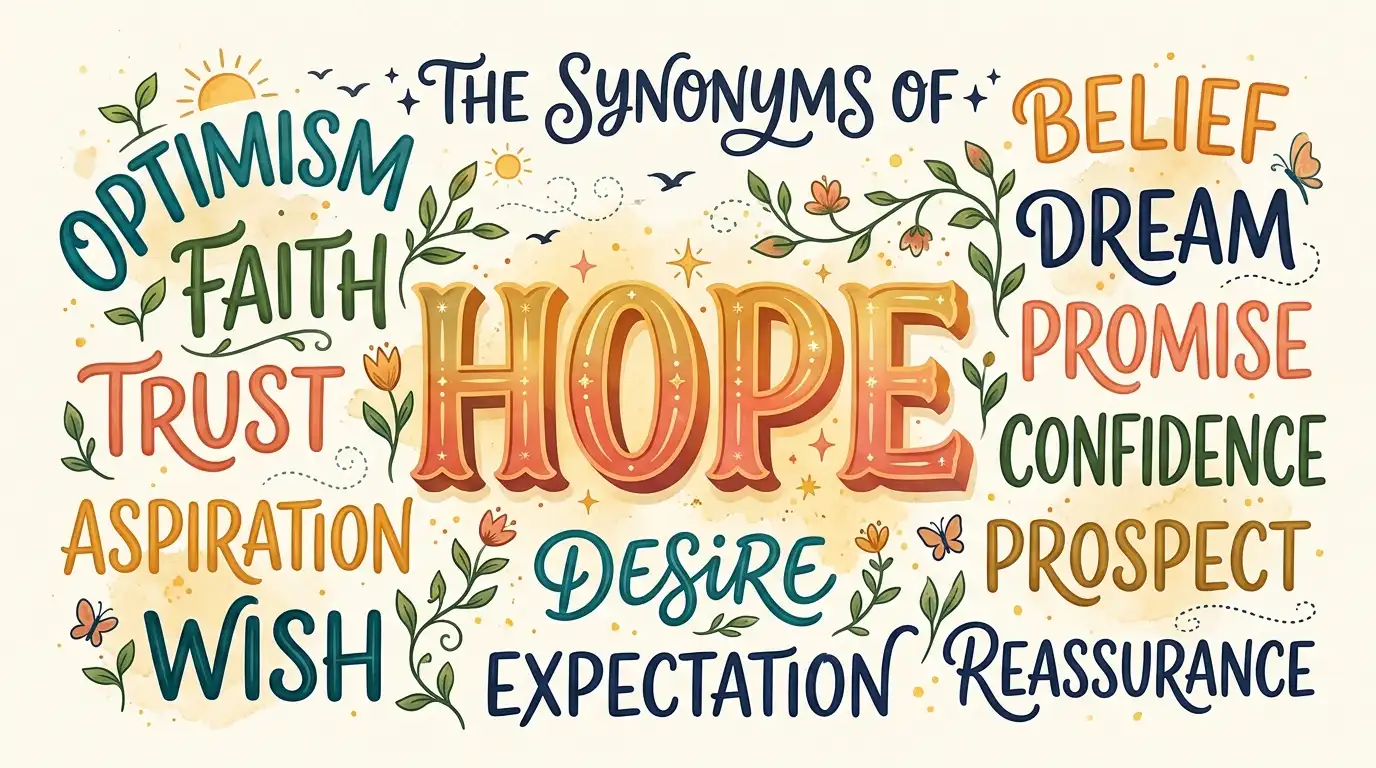
Hope means a feeling that something good may happen or a wish for a better future.
A Word in Everyday Life
Imagine a student waiting for exam results. The student feels nervous but believes that good news may come. This feeling is called hope. People use the word when they want something good to happen or believe that a problem may improve. The phrase hope synonyms includes words such as wish, faith, trust, and expectation. Some words show a strong belief, while others express a simple desire. This guide explains their meanings, shows how to use them, and helps you choose the right word for each situation.
Understanding Hope Synonyms
Simple meaning: Hope is a feeling that something good may happen. It can also mean wanting something to happen or believing that it is possible.
Part of speech: Hope can be used as both a noun and a verb.
- Noun: It describes a feeling, wish, or belief about something good.
- Verb: It means to want something to happen or believe it may happen.
Example in context: I hope my family can visit us next month.
The word can express different ideas:
- A positive feeling: She has hope that life will get better.
- A wish: My hope is to become a teacher.
- A belief about the future: We hope the weather will be sunny.
- A person or thing that may bring success: The young player is the team’s last hope.
Best Alternatives to Hope Synonyms
Here are some useful words that can replace hope in different situations.
| Alternative | Simple meaning | Best use |
| Wish | Something you want to happen | Everyday speech |
| Expectation | A belief about what may happen | School and formal writing |
| Faith | Strong belief or trust | Personal beliefs |
| Trust | Belief that someone or something is good or reliable | Relationships |
| Optimism | A positive way of thinking | Daily life |
| Desire | A strong want for something | Personal goals |
| Dream | Something you really want to achieve | Future plans |
| Aspiration | A strong goal for the future | Education and work |
| Confidence | Belief that something can succeed | Work and personal goals |
| Promise | A sign that something good may happen | Future events |
| Possibility | Something that may happen | General discussion |
| Expect | To believe something may happen | Verb use |
These words have close meanings, but they do not all fit every sentence. The best choice depends on what you want to express.
Synonyms of Hope by Situation
Everyday Words for Hope
These words are useful in normal conversations, messages, and simple writing. They express a wish, a positive feeling, or a belief about the future.
Wish — Something you want to happen.
Example: My wish is to see my grandparents soon.
Desire — A strong feeling of wanting something.
Example: She has a desire to learn new skills.
Dream — Something you strongly want to do or achieve.
Example: His dream is to own a small house.
Want — To wish to have or do something.
Example: I want to find a good job.
Longing — A strong feeling of wanting something or someone.
Example: He felt a longing to return to his hometown.
Expectation — A belief that something may happen.
Example: We have an expectation of good results.
Outlook — The way someone thinks about what may happen in the future.
Example: Her outlook became better after the good news.
Chance — An opportunity for something to happen.
Example: There is still a chance that we can win.
Words That Show Strong Belief
Sometimes hope is more than a simple wish. It can show that someone believes in a person, plan, or future result. These words are useful when you want to express trust and belief.
Faith — Strong belief that something will happen or that someone can be trusted.
Example: She has faith in her family’s support.
Trust — Belief that someone or something is reliable.
Example: I trust that my friend will help me.
Confidence — A feeling that something will work well.
Example: The team has confidence in its plan.
Conviction — A strong belief that something is true or right.
Example: He spoke with conviction about his future.
Assurance — A feeling of being sure about something.
Example: Her kind words gave me assurance.
Belief — A feeling that something is true or possible.
Example: His belief in success kept him working.
Certainty — A state of being sure about something.
Example: She had certainty that her hard work would help her.
Reliance — The act of depending on someone or something.
Example: Their reliance on teamwork helped them finish the task.
Positive Words for a Better Future
These words express a bright view of what may happen. They work well when discussing goals, new plans, or better times ahead.
Optimism — A way of thinking that expects good things.
Example: Her optimism helped the group stay calm.
Positivity — A habit of focusing on good things.
Example: His positivity made the difficult day easier.
Encouragement — Words or actions that give someone support.
Example: The teacher’s encouragement helped me prepare for the test.
Promise — A sign that something good may happen.
Example: The new plan shows promise.
Prospect — A chance or possibility of something happening in the future.
Example: She was happy about the prospect of a new job.
Potential — The ability or chance to become something better.
Example: The young artist has great potential.
Bright future — A future that seems likely to bring success or happiness.
Example: The hard-working student has a bright future.
Silver lining — A good part of a situation that is mostly bad.
Example: Losing the match had a silver lining because we learned from our mistakes.

Words for Goals and Future Plans
Hope can also describe something a person wants to achieve. These alternatives are useful in schoolwork, job plans, and personal writing.
Aspiration — A strong goal that someone wants to reach.
Example: Her aspiration is to become a doctor.
Ambition — A strong wish to achieve something important.
Example: His ambition is to start his own business.
Goal — Something a person plans to achieve.
Example: My goal is to improve my English.
Aim — Something you want to do or reach.
Example: Our aim is to complete the project this week.
Objective — A clear result that someone wants to achieve.
Example: The main objective is to help more students.
Plan — An idea about what you will do in the future.
Example: She has a plan to study abroad.
Vision — An idea of what you want the future to look like.
Example: The leader shared a vision for a better school.
Ambition for success — A strong wish to do well.
Example: His ambition for success pushed him to keep learning.
Phrases That Express Hope
Sometimes a short phrase explains a feeling better than one word. These expressions are useful in daily speech, personal messages, and writing.
Look forward to — To feel happy about something that will happen.
Example: I look forward to meeting my new classmates.
Keep faith — To continue believing that things can improve.
Example: We must keep faith during difficult times.
Hold on to hope — To keep believing that something good may happen.
Example: She decided to hold on to hope.
Have high hopes — To strongly expect a good result.
Example: The coach has high hopes for the team.
Hope for the best — To expect a good result even when the result is not certain.
Example: We have done our work, so now we hope for the best.
A ray of hope — A small sign that things may improve.
Example: The good news gave the family a ray of hope.
A reason to believe — Something that makes a positive result seem possible.
Example: Their progress gave us a reason to believe.
Keep your fingers crossed — To wish for a good result.
Example: Keep your fingers crossed for my exam results.
Words Similar to Hope but with Different Meanings
Some words are close to hope but express a different idea. Understanding these differences helps you choose the right word.
Faith vs. Hope
Faith: Faith means strong belief or trust in someone or something.
Difference: Hope is a wish or belief about a good result. Faith is often a deeper belief or trust. A person can have hope without feeling complete faith.
Example: She has faith in her family and hopes they will support her plan.
Wish vs. Hope
Wish: A wish is something someone wants to happen.
Difference: Hope often suggests that a good result may really happen. A wish can be about something that is unlikely or impossible.
Example: I wish I could fly, but I hope I can travel next summer.
Optimism vs. Hope
Optimism: Optimism is a positive way of thinking about life and the future.
Difference: Hope can focus on one result, while optimism is a wider positive attitude.
Example: Her optimism helps her stay positive, and she hopes to pass the exam.
Expectation vs. Hope
Expectation: An expectation is a belief about what is likely to happen.
Difference: Hope expresses a desire for a good result. An expectation may be positive, negative, or neutral.
Example: I hope the team wins, but my expectation is that the match will be close.
Confidence vs. Hope
Confidence: Confidence means believing that you or someone else can do something well.
Difference: Hope does not always mean you are sure about success. Confidence shows a stronger belief in ability or success.
Example: I hope to pass the test, and I have confidence in my preparation.
Dream vs. Hope
Dream: A dream can be a strong wish for something you want in life.
Difference: Hope can relate to a small event or a big goal. A dream often describes a personal goal that may take a long time to reach.
Example: I hope to get a good result this year, and my dream is to become a scientist.
How to Choose the Right Synonym
The right word can make a sentence clearer. Look at these examples to understand how the meaning changes.
Comparison 1: Waiting for good news
Original: I hope I get good news tomorrow.
Option 1: I wish I could get good news tomorrow.
Option 2: I expect good news tomorrow.
What changes: Wish expresses what you want, while expect suggests that you think it may happen.
Comparison 2: Trusting a friend
Original: I hope my friend will help me.
Option 1: I trust my friend to help me.
Option 2: I have faith in my friend.
What changes: Trust and faith show stronger belief in the person than a simple wish.
Comparison 3: Planning a future career
Original: My hope is to become a teacher.
Option 1: My dream is to become a teacher.
Option 2: My ambition is to become a teacher.
What changes: Dream sounds personal, while ambition shows a strong desire to reach a goal.
Comparison 4: Staying positive
Original: We hope things will get better.
Option 1: We remain optimistic about the future.
Option 2: We believe there is a possibility of improvement.
What changes: Optimistic describes a positive attitude, while possibility focuses on what may happen.
Comparison 5: Talking about a new plan
Original: The new plan gives us hope.
Option 1: The new plan gives us confidence.
Option 2: The new plan shows promise.
What changes: Confidence shows belief in success, while promise means the plan seems likely to work well.
Comparison 6: Working toward a goal
Original: Her hope is to study abroad.
Option 1: Her aspiration is to study abroad.
Option 2: Her goal is to study abroad.
What changes: Aspiration shows a strong personal wish, while goal sounds like a clear result she plans to reach.
Common Mistakes When Using Hope Synonyms
Choosing a similar word without checking its meaning can make a sentence unclear. Here are some common mistakes and better ways to write them.
Using Wish When You Mean Expect
Unsuitable: I wish the bus will arrive soon.
Problem: Wish is not the best choice when you are talking about something you think may happen.
Better: I hope the bus will arrive soon.
Using Faith for Every Kind of Hope
Unsuitable: My faith is to visit my cousin tomorrow.
Problem: Faith means strong belief or trust. It does not usually replace hope when talking about a simple plan.
Better: My hope is to visit my cousin tomorrow.
Confusing Optimism with a Single Wish
Unsuitable: My optimism is to pass the exam.
Problem: Optimism is a positive way of thinking, not usually one specific goal.
Better: My hope is to pass the exam.
Using Expectation When You Mean a Strong Goal
Unsuitable: My expectation is to become a nurse.
Problem: Expectation is more often used for what someone thinks will happen. A personal life goal is better described as an ambition or aspiration.
Better: My ambition is to become a nurse.

Replacing Hope with Confidence Without Checking the Meaning
Unsuitable: I have confidence that my lost keys will be found.
Problem: Confidence often suggests a strong belief in someone’s ability or a likely result. In this sentence, hope sounds more natural if the result is uncertain.
Better: I hope my lost keys will be found.
Using a Noun Instead of a Verb
Unsuitable: I expectation to get a good result.
Problem: Expectation is a noun. The verb expect is needed in this sentence.
Better: I expect to get a good result.
Tips for Using Hope Alternatives Naturally
Here are some simple ways to choose the right word when writing about hope.
- Think about your meaning. Use wish when you want something, faith when you trust something, and optimism when you have a positive view of the future.
- Choose words for your audience. Words such as wish, dream, and goal are easy to understand in everyday writing. Aspiration and conviction may suit more formal writing.
- Check how strong the feeling is. Hope can express a simple desire. Faith and confidence usually show a stronger belief.
- Use the correct form. Hope is both a noun and a verb. Expectation is a noun, while expect is a verb.
- Avoid repeating the same word. If you use hope several times, you may replace some uses with wish, dream, or goal when the meaning fits.
Revision example 1:
Before: I hope to get a good job. I hope to earn more money.
After: I hope to get a good job. My goal is to earn more money.
The second sentence is clearer because it explains what the person wants to achieve.
Revision example 2:
Before: She has hope in her team. She has hope that they will win.
After: She has faith in her team. She hopes they will win.
The revised version uses faith for trust and hopes for the result.
Revision example 3:
Before: His hope is to become a doctor. His hope is to help sick people.
After: His dream is to become a doctor. He wants to help sick people.
The new version avoids repetition and keeps the meaning clear.
Frequently Asked Questions
What does hope mean?
Hope means wanting something good to happen or believing that it may happen. It can also describe a positive feeling about the future.
What is the closest synonym for hope?
Wish is one of the closest everyday alternatives when hope means wanting something to happen. Faith may fit better when hope means strong belief or trust.
What is a simple alternative to hope?
Wish is a simple alternative in many everyday sentences. Dream, trust, and belief can also work when the meaning fits.
Can I use hope and its synonyms interchangeably?
No, not in every sentence. Wish, faith, optimism, and expectation have different meanings, so you should choose the word that matches your message.
Final Takeaway
There are many ways to express a positive wish or belief about the future. Words such as wish, faith, dream, optimism, and confidence can make your writing more clear and interesting. However, each word has its own meaning and use. When choosing hope synonyms, think about the feeling you want to show. Pick two or three new words from this guide and practise using them in your own sentences.

Emily Carter is the editor and lead writer at The Synonymsly. With a background in English language and editorial writing, she has spent the past seven years helping students, writers and professionals find exactly the right word. Emily creates clear, practical synonym guides with real example sentences, carefully checking meaning, tone and usage so readers can expand their vocabulary with confidence. Away from her desk, she enjoys reading classic novels and collecting interesting words she hears in everyday conversation.