

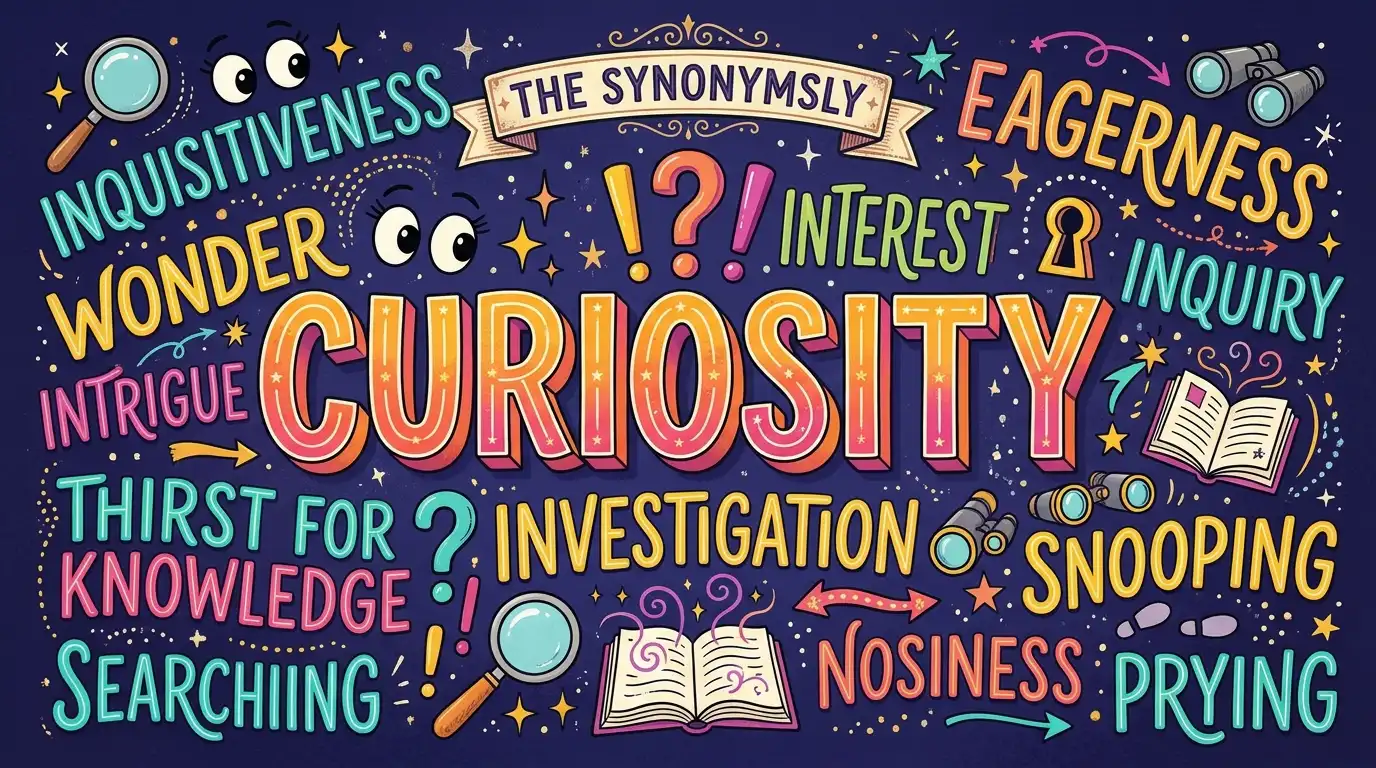
Curiosity means wanting to know, learn, or find out something new.
Curiosity is the feeling that makes us ask questions and look for answers. It helps us learn about people, places, things, and new ideas. There are many words that can express this feeling. Some show a simple wish to learn, while others show a strong interest in something. In this guide, you will find useful curiosity synonyms, their easy meanings, and examples. You will also learn how to choose the right word for your sentence.
Understanding Curiosity
Curiosity is a feeling that makes someone want to know more about something. A curious person asks questions, looks for answers, and enjoys learning new things.
For example:
- The child showed curiosity about the stars.
- Her curiosity made her read more about animals.
- I was curious to know how the machine worked.
Curiosity is a noun. The word curious is an adjective.
- Curiosity: His curiosity helped him learn.
- Curious: She was curious about the new school.
Best Alternatives for Curiosity
| Word or phrase | Simple meaning | Example |
| Interest | Wanting to know more | He has an interest in space. |
| Wonder | Wanting to understand something | I looked at the sky in wonder. |
| Eagerness | Being very ready to learn | Her eagerness helped her study. |
| Fascination | A very strong interest | He has a fascination with birds. |
| Inquisitiveness | A wish to ask questions | The child’s inquisitiveness was clear. |
| Desire to learn | Wanting to gain new knowledge | Her desire to learn is strong. |
| Love of learning | Enjoying the act of learning | His love of learning is clear. |
| Need to know | A strong wish to find an answer | I had a need to know the truth. |
| Thirst for knowledge | A strong wish to learn | She has a thirst for knowledge. |
| Wonderment | A feeling of great surprise | The view filled us with wonderment. |
Synonyms by Situation

1. Simple Words for Everyday Use
These words work well when you want to talk about a normal wish to learn or know more.
- Interest: Wanting to know about something.
Example: She has an interest in history. - Wonder: Wanting to know why or how something happens.
Example: The child looked at the moon in wonder. - Desire to know: Wanting to find out an answer.
Example: He had a desire to know what happened. - Wish to learn: Wanting to learn something new.
Example: Her wish to learn helped her improve. - Interest in learning: Enjoying the chance to learn.
Example: His interest in learning grew each day. - Questioning nature: Often asking questions.
Example: Her questioning nature helped her understand the lesson.
2. Words for a Strong Interest
Use these words when someone is very interested in a subject or activity.
- Fascination: A very strong interest in something.
Example: She has a fascination with sea animals. - Eagerness: Being very ready and happy to learn.
Example: His eagerness to learn made his teacher happy. - Enthusiasm: Showing strong interest and excitement.
Example: The students showed enthusiasm during the science lesson. - Love of learning: Enjoying learning new things.
Example: Her love of learning began at a young age. - Thirst for knowledge: A strong wish to learn more.
Example: He has a thirst for knowledge. - Passion for learning: A deep love of learning.
Example: Her passion for learning helped her reach her goals.
3. Words for Surprise and New Things
These words can describe the feeling of seeing or learning something new.
- Wonderment: A feeling of great surprise.
Example: The children watched the fireworks with wonderment. - Amazement: A strong feeling of surprise.
Example: The magic trick filled us with amazement. - Interest in discovery: Wanting to find something new.
Example: His interest in discovery led him to explore the forest. - Sense of wonder: A feeling of joy when seeing something new.
Example: The night sky gave her a sense of wonder. - Desire to explore: Wanting to visit or learn about new places.
Example: Their desire to explore took them to the mountains.
4. Words for Wanting to Know About People
Curiosity can also be about other people, their lives, or their actions. Choose your words with care so they do not sound rude.
- Interest in others: Wanting to know about other people.
Example: She showed an interest in her new classmates. - Desire to understand: Wanting to understand another person’s thoughts.
Example: He had a desire to understand his friend. - Nosiness: Asking too much about another person’s private life.
Example: His nosiness made others feel uncomfortable. - Questioning: Asking questions to get information.
Example: Her questioning helped clear up the problem.
5. Phrases for Learning and Exploring
Sometimes a short phrase works better than one word.
- Wish to find out: Wanting to get an answer.
Example: I had a wish to find out how the game worked. - Need to understand: Wanting to understand something clearly.
Example: She had a need to understand the lesson. - Love of discovery: Enjoying finding new things.
Example: His love of discovery made science fun. - Desire to ask questions: Wanting to ask and learn.
Example: The student had a desire to ask questions. - Wish to explore: Wanting to see or learn about something new.
Example: Their wish to explore took them to a new town.
Similar Words but Different Meanings
Some words are close in meaning to curiosity, but they are not always the same. Knowing the difference can help you choose the right word.
1. Interest vs. Curiosity
Interest means liking or caring about something. Curiosity means wanting to know more about it.
- Interest: He has an interest in football.
- Curiosity: He asked how football rules work.
2. Fascination vs. Curiosity
Fascination means a very strong interest. Curiosity can be a simple wish to learn.
- Fascination: She has a fascination with space.
- Curiosity: She asked how planets move.
3. Nosiness vs. Curiosity
Nosiness means asking too much about other people’s private lives. Curiosity can be a good wish to learn.
- Nosiness: He kept asking about his neighbour’s personal life.
- Curiosity: He asked how his neighbour made a garden.
4. Wonder vs. Curiosity
Wonder is a feeling of surprise or interest. Curiosity is the wish to find out more.
- Wonder: The child looked at the stars in wonder.
- Curiosity: The child asked why stars shine.
5. Investigation vs. Curiosity
Investigation means looking closely for facts or answers. Curiosity is the wish that may lead someone to investigate.
- Investigation: The team looked for clues.
- Curiosity: The mystery made the team want to learn more.
How to Choose the Right Synonym
The best word depends on what you want to say.
1. Use Interest for a General Feeling
Choose interest when someone likes a subject or wants to know about it.
Example: She has an interest in art.
2. Use Fascination for a Strong Feeling
Choose fascination when someone has a very strong interest in something.
Example: He has a fascination with trains.
3. Use Wonder for Surprise
Choose wonder when someone feels amazed or wants to understand something special.
Example: The child watched the birds in wonder.
4. Use Eagerness for a Wish to Learn
Choose eagerness when someone is ready and excited to learn.
Example: Her eagerness to read helped her improve.
5. Use Nosiness for Rude Questions
Choose nosiness when someone asks too much about another person’s private life.
Example: His nosiness upset his friends.
6. Use Thirst for Knowledge for a Strong Wish to Learn
This phrase works when someone always wants to gain more knowledge.
Example: Her thirst for knowledge helped her learn many new things.

Common Mistakes
Here are some mistakes people may make when using curiosity and its related words.
1. Using Interest and Curiosity in the Same Way Every Time
These words are close, but they have different meanings. Interest is about liking something. Curiosity is about wanting to know more.
2. Using Nosiness as a Positive Word
Nosiness often has a negative meaning. It can describe someone who asks questions about things that are not their business.
3. Using Fascination for a Small Interest
Fascination is a strong feeling. Use interest when the feeling is simple or mild.
4. Using Wonder When You Mean a Question
Wonder often describes a feeling. If you mean that someone wants an answer, curiosity may be a better choice.
5. Adding Too Many Synonyms to One Sentence
Using many similar words can make a sentence unclear. Choose one word that gives the meaning you want.
Practical Writing Tips
Use these tips to make your writing clear and easy to understand.
- Think about the meaning: Choose a word that matches your message.
- Use simple words: Interest and wonder are good choices for everyday writing.
- Check the sentence: Read your sentence again to make sure the word fits.
- Avoid repeating words: Use another suitable word when you have used curiosity many times.
- Know the feeling: Use fascination for a strong interest and eagerness for being ready to learn.
- Use nosiness with care: This word can make a person sound rude.
- Read your sentence aloud: This can help you find words that do not sound right.
Frequently Asked Questions
1. What is the best synonym for curiosity?
Interest is a common and simple synonym for curiosity. However, the best word depends on the sentence. Wonder, eagerness, and fascination may also work.
2. What is another word for curiosity in simple English?
Interest is one of the easiest words to use. It means wanting to know or learn about something.
3. What is a strong word for curiosity?
Fascination is a strong word for curiosity. It means having a very strong interest in something.
4. Is curiosity a good thing?
Yes, curiosity can be a good thing. It helps people ask questions, learn new skills, and understand the world around them. However, it is important to respect other people’s privacy.
Final Takeaway
Curiosity means wanting to know or learn more about something. Words such as interest, wonder, eagerness, and fascination can express this feeling in different ways. The right choice depends on your sentence and the meaning you want to share. Use simple words when they fit, and remember that nosiness has a negative meaning. Learning these words can help make your speaking and writing clear.

Emily Carter is the editor and lead writer at The Synonymsly. With a background in English language and editorial writing, she has spent the past seven years helping students, writers and professionals find exactly the right word. Emily creates clear, practical synonym guides with real example sentences, carefully checking meaning, tone and usage so readers can expand their vocabulary with confidence. Away from her desk, she enjoys reading classic novels and collecting interesting words she hears in everyday conversation.