

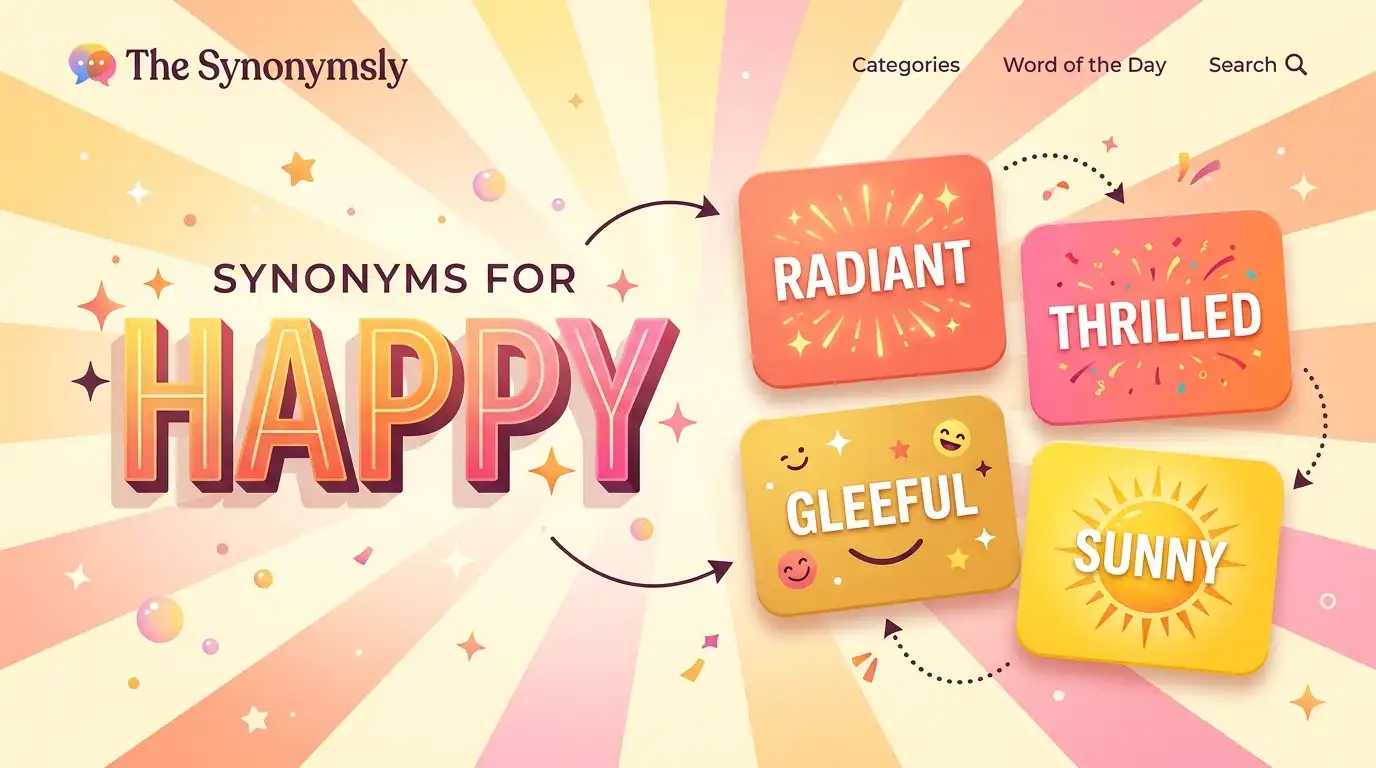
Happy means feeling good, feeling glad, or having joy in your heart.
Imagine getting a gift, meeting your best friend, or passing an exam. These things can make you feel happy. But you do not always need to use the same word to talk about your feelings. There are many easy words that can mean happy. Words like glad, joyful, cheerful, pleased, and excited can help you share your feelings in a better way. In this guide, you will learn simple happy synonyms, their meanings, and how to use them in daily talks, schoolwork, and writing.
Understanding Happy Synonyms
Simple meaning: Happy means feeling good because of something nice. It can also mean enjoying life and feeling good about what you have.
Part of speech: Happy is an adjective. It tells us how a person feels.
Example in context: I feel happy when I spend time with my family.
The word happy can describe many good feelings.
- Feeling glad: You feel good because something nice has happened.
- Feeling joyful: You feel full of joy.
- Feeling pleased: You like something that has happened.
- Feeling calm: You feel good and have no worries.
- Feeling excited: You feel full of energy about something nice.
- Feeling proud: You feel good about something you have done.
Happy is a simple word that we use every day. You can feel happy when you meet a friend, eat your favorite food, get good marks, or go on a trip.
Best Alternatives to Happy Synonyms
Here are some easy words that you can use instead of happy.
| Alternative | Simple meaning | Best use |
| Glad | Feeling good about something | Daily talks |
| Joyful | Full of joy | Special days |
| Cheerful | Having a happy mood | Daily life |
| Pleased | Feeling good about something | School and work |
| Delighted | Very happy | Gifts and good news |
| Merry | Happy and ready to have fun | Parties |
| Content | Happy with what you have | Home life |
| Thrilled | Very excited and happy | Big events |
| Jolly | Happy and full of fun | Friendly talks |
| Elated | Feeling very happy | Winning a prize |
| Blissful | Feeling deep happiness | Peaceful times |
| Upbeat | Feeling good and hopeful | Work and daily life |
Synonyms of Happy by Situation
Different times bring different kinds of happiness. Sometimes you feel happy in a simple way. At other times, you may feel very excited or calm. These word groups will help you choose the right word for each moment.
Everyday Words
These words are simple and easy to use. You can use them when talking with friends, family, teachers, and other people.
Glad — Feeling good because something nice has happened.
Example: I am glad you came to my house.
Cheerful — Having a happy and bright mood.
Example: My sister is always cheerful in the morning.
Pleased — Feeling good about something you like.
Example: My father was pleased with my school marks.
Merry — Feeling happy and ready to have fun.
Example: The children were merry at the birthday party.
Jolly — Being happy, friendly, and full of fun.
Example: Our grandfather is a jolly man who makes us laugh.
Lighthearted — Feeling free from worry.
Example: We had a lighthearted talk after dinner.
Good-humored — Having a kind and happy mood.
Example: Our teacher stayed good-humored during the long class.
Satisfied — Feeling good because something went well.
Example: I felt satisfied after finishing my homework.
Bright — Having a happy look or mood.
Example: She gave me a bright smile when I entered the room.
Smiling — Showing happiness with a smile.
Example: The smiling child welcomed his friends.
These words are useful in daily life. You can use them in messages, school stories, and talks with people you know.
Words That Show Strong Happiness
Sometimes, glad is not enough to show how happy you feel. You may feel very happy after winning a game, getting a new job, or hearing good news. These words show a strong feeling of happiness.
Joyful — Feeling full of joy.
Example: The family was joyful when their baby came home.
Delighted — Feeling very happy about something.
Example: She was delighted to get a gift from her friend.
Thrilled — Feeling very excited and happy.
Example: Ali was thrilled when he won the school race.
Elated — Feeling very happy after doing something well.
Example: The players were elated after winning the final match.
Ecstatic — Feeling extremely happy.
Example: My sister was ecstatic about her new job.
Overjoyed — Feeling more joy than usual.
Example: His parents were overjoyed when he passed his exams.
Jubilant — Feeling great joy after a win.
Example: The jubilant students cheered for their team.
Excited — Feeling full of energy and joy.
Example: We were excited about our school trip.
On cloud nine — Feeling extremely happy.
Example: I was on cloud nine after hearing the good news.
Over the moon — Feeling very happy about something.
Example: My mother was over the moon when I got good marks.
Use these words when something makes you very happy. For small things, glad or pleased may be a better choice.
Words for Calm and Peaceful Happiness
Happiness does not always mean laughing or jumping with joy. Sometimes, you feel happy when you sit with your family, read a book, or enjoy a quiet day. These words describe that kind of happiness.
Content — Feeling happy with what you have.
Example: She felt content while reading a book in her garden.
Contented — Feeling calm and happy with your life.
Example: The old man looked contented in his small home.
Blissful — Feeling deep and peaceful happiness.
Example: They spent a blissful afternoon near the lake.
Peaceful — Feeling calm and free from trouble.
Example: I had a peaceful day at home with my family.
At ease — Feeling comfortable and relaxed.
Example: I felt at ease when my friends welcomed me.
Carefree — Feeling happy because you have few worries.
Example: The children enjoyed a carefree day at the beach.
Fulfilled — Feeling good because you have done something important.
Example: She felt fulfilled after helping other people.
Gratified — Feeling pleased because something good has happened.
Example: The teacher felt gratified by her students’ progress.
Relaxed — Feeling calm and free from stress.
Example: I felt relaxed after spending the evening with my family.
Comfortable — Feeling good in a place or with people.
Example: The guests felt comfortable in our home.
These words are useful when you want to talk about a quiet and calm kind of happiness. They work well in stories about family, friends, and home life.
Formal and School-Friendly Words
Some words are useful in school essays, letters, and work. They help you talk about good results, success, and good feelings.
Gratified — Feeling pleased because of a good result.
Example: The teacher felt gratified by the students’ hard work.
Delighted — Feeling very pleased about something.
Example: We are delighted to welcome our new students.
Pleased — Feeling good about a result.
Example: The teacher was pleased with my project.
Satisfied — Feeling good because your needs have been met.
Example: The customer was satisfied with the service.
Optimistic — Feeling that good things may happen.
Example: The team was optimistic about the coming year.
Upbeat — Having a happy and hopeful mood.
Example: The manager gave an upbeat talk to the workers.
Cheery — Showing a happy and friendly mood.
Example: Her cheery greeting made everyone smile.
Grateful — Feeling thankful for something good.
Example: I am grateful for my teacher’s help.
Proud — Feeling good about your own work or someone else’s success.
Example: My parents are proud of my school results.
Warm — Showing kindness and friendly feelings.
Example: She gave us a warm welcome at her home.
These words can make your schoolwork better. Remember that they do not all mean the same thing. Grateful means thankful, while optimistic means you think good things may happen.
Casual and Friendly Expressions
When talking with friends and family, you can use short phrases to show happiness. These phrases are easy to understand and sound natural in daily talks.
Walking on air — Feeling very happy and excited.
Example: He was walking on air after his wedding.
In high spirits — Feeling happy and full of energy.
Example: Everyone was in high spirits at the picnic.
On top of the world — Feeling very happy.
Example: She felt on top of the world after passing her exams.
In a good mood — Feeling happy and pleasant.
Example: My brother is in a good mood today.
Full of joy — Feeling a lot of happiness.
Example: The little girl was full of joy on her birthday.
Tickled pink — Feeling very pleased about something.
Example: Grandma was tickled pink by the handmade card.
Happy as can be — Feeling very happy.
Example: The children were happy as can be during the school trip.
Having a great time — Enjoying yourself very much.
Example: We were having a great time at the family party.
Feeling great — Feeling very good and happy.
Example: I am feeling great after meeting my old friends.
All smiles — Looking very happy.
Example: The students were all smiles after the school trip.
These phrases are good for friendly talks, text messages, and stories. They may not be right for every school report or work letter.
Words Similar to Happy but with Different Meanings
Some words are close to happy, but they do not mean exactly the same thing. Learning the small differences will help you choose the right word.
Excited vs. Happy
Excited: Feeling full of energy because something nice is going to happen.
Difference: Happy tells us how you feel. Excited often means you are looking forward to something.
Example: I am excited about tomorrow’s school trip.
You can feel happy while sitting quietly at home. But excited usually means you are waiting for something nice to happen.
Lucky vs. Happy
Lucky: Having something good happen by chance.
Difference: Lucky tells us about good luck, not feelings. A lucky person may also feel happy.
Example: I was lucky to find my lost wallet.
You can say, “I am happy that I found my wallet.” This tells us how you feel. You can also say, “I was lucky to find my wallet.” This tells us that something good happened by chance.
Proud vs. Happy
Proud: Feeling good about something you or another person has done.
Difference: Proud is often linked to success or hard work. Happy can describe many different feelings.
Example: My parents are proud of my school results.
You may feel proud when you win a prize. You may also feel happy when you spend time with your friends.
Peaceful vs. Happy
Peaceful: Feeling calm and free from noise or trouble.
Difference: Peaceful describes a calm feeling. Happy describes a good feeling.
Example: I enjoy sitting in a peaceful garden.
A person can feel peaceful and happy at the same time, but the words do not always mean the same thing.
Hopeful vs. Happy
Hopeful: Thinking that something good may happen.
Difference: Hopeful is about the future, while happy tells us how you feel now.
Example: She is hopeful about getting a new job.
You can feel hopeful about passing an exam before you get your result. You feel happy when you hear that you have passed.

How to Choose the Right Synonym
The right word depends on the moment and the feeling you want to show. Here are some easy examples to help you understand the differences.
Original: I am happy to see you.
Option 1: I am glad to see you.
Option 2: I am delighted to see you.
What changes: Glad is simple and friendly. Delighted shows a stronger feeling.
Original: She was happy after winning the match.
Option 1: She was thrilled after winning the match.
Option 2: She was jubilant after winning the match.
What changes: Thrilled shows excitement, while jubilant shows great joy after a win.
Original: He is happy with his new home.
Option 1: He is content with his new home.
Option 2: He is pleased with his new home.
What changes: Content shows calm happiness, while pleased shows that he likes his new home.
Original: The children were happy at the party.
Option 1: The children were cheerful at the party.
Option 2: The children were merry at the party.
What changes: Cheerful tells us about their mood, while merry shows that they are having fun.
Original: I feel happy about my future.
Option 1: I feel optimistic about my future.
Option 2: I feel hopeful about my future.
What changes: Both words show that you think good things may happen later.
Original: She was happy when she got the gift.
Option 1: She was overjoyed when she got the gift.
Option 2: She was ecstatic when she got the gift.
What changes: Both words show strong happiness, but ecstatic is even stronger.
Original: We were happy during our holiday.
Option 1: We were carefree during our holiday.
Option 2: We had a blissful holiday.
What changes: Carefree shows that we had no worries, while blissful shows deep happiness.
Original: My teacher was happy with my work.
Option 1: My teacher was pleased with my work.
Option 2: My teacher was satisfied with my work.
What changes: Pleased shows that the teacher liked the work, while satisfied shows that the work was good enough.
Common Mistakes When Using Happy Synonyms
Using new words can make your writing better. But you should know what each word means before using it. Here are some common mistakes and easy ways to fix them.
Using Excited When You Mean Happy
Unsuitable: I am excited because I had a nice lunch.
Problem: Excited often means you are looking forward to something. It may not fit a simple good feeling.
Better: I am happy because I had a nice lunch.
Using Lucky Instead of Glad
Unsuitable: I am lucky that you came to visit me.
Problem: Lucky is about good luck. Glad tells us how you feel about someone’s visit.
Better: I am glad that you came to visit me.
Using Ecstatic for Small Things
Unsuitable: I was ecstatic when I found my pencil.
Problem: Ecstatic is a very strong word. It is better for big and exciting moments.
Better: I was pleased when I found my pencil.
Using Content in the Wrong Way
Unsuitable: The children were content when their team won the final.
Problem: Content means calm and happy. It does not show strong joy after a big win.
Better: The children were thrilled when their team won the final.
Confusing Happy and Happily
Incorrect: She happily girl smiled at me.
Problem: Happy tells us how a person feels. Happily tells us how someone does something.
Better: The happy girl smiled at me.
You can also say, “The girl smiled happily at me.”
Using Too Many Similar Words
Unsuitable: I was happy, glad, joyful, cheerful, and delighted to see him.
Problem: These words have close meanings. Using all of them in one sentence makes it sound repeated.
Better: I was delighted to see him.
Using Formal Words in Daily Talks
Unsuitable: I am gratified that you brought me a glass of water.
Problem: Gratified is not a common word for a simple daily talk.
Better: I am glad you brought me a glass of water.
Using a Strong Word for a Small Feeling
Unsuitable: I was overjoyed to find my shoes.
Problem: Overjoyed shows a very strong feeling. It may be too much for a small event.
Better: I was happy to find my shoes.
Tips for Using Happy Alternatives Naturally
You can make your writing clear and easy to read by using different words in the right places. Here are some simple tips.
- Think about your feeling: Use glad for a simple good feeling, thrilled for excitement, and content for calm happiness.
- Look at the situation: A birthday party may call for joyful, while a quiet evening may suit peaceful or content.
- Use easy words in daily talks: Glad, pleased, and cheerful are good words for normal talks.
- Choose strong words for big moments: Use ecstatic, overjoyed, or elated when something very special happens.
- Do not use the same word again and again: Try another word when happy appears many times in your writing.
- Use friendly phrases with friends: Words like over the moon and on cloud nine are good for friendly talks and messages.
- Check the meaning: Make sure the new word says what you really want to say.
Here are some easy ways to make your sentences better.
Before: I was happy when I passed my exam. My mother was happy too.
After: I was thrilled when I passed my exam. My mother was delighted too.
The second version uses two different words and makes the writing more fun to read.
Before: We were happy during our holiday because we had no worries.
After: We enjoyed a carefree holiday because we had no worries.
The new sentence gives us a better picture of the holiday.
Before: My friend was happy to see me, and I was happy to see him.
After: My friend was glad to see me, and I was delighted to see him.
The new version does not repeat the same word.
Before: The children were happy because they won the game.
After: The children were overjoyed because they won the game.
The second sentence shows a stronger feeling after the win.

Frequently Asked Questions
What are the closest synonyms for happy?
Glad, joyful, cheerful, and pleased are some of the closest words to happy. You can use them in daily talks and simple sentences. The right word depends on the feeling you want to show.
What is an easy word for happy?
Glad is one of the easiest words to use instead of happy. It works well in daily talks, schoolwork, and friendly messages. For example, “I am glad you came.”
What is a stronger word for happy?
Ecstatic, overjoyed, and elated are strong words for happy. They show a very high level of joy. You can use them when someone wins a prize, gets good news, or reaches an important goal.
Can happy and joyful be used in the same way?
Yes, happy and joyful can be used in many of the same sentences. However, joyful often shows a deeper feeling of joy. Happy is a more common word that can describe many kinds of good feelings.
Final Takeaway
There are many ways to talk about good feelings. Words like glad, cheerful, joyful, pleased, and delighted can make your writing clear and fun to read. Some words show strong joy, while others describe a calm and peaceful feeling. When choosing happy synonyms, think about the moment and the feeling you want to share. Pick two or three new words from this guide and use them in your own sentences every day.

Emily Carter is the editor and lead writer at The Synonymsly. With a background in English language and editorial writing, she has spent the past seven years helping students, writers and professionals find exactly the right word. Emily creates clear, practical synonym guides with real example sentences, carefully checking meaning, tone and usage so readers can expand their vocabulary with confidence. Away from her desk, she enjoys reading classic novels and collecting interesting words she hears in everyday conversation.